Although an earlier Businessweek article described that the planned MasterCard International Inc. IPO may occur in the first quarter of 2006, the Wall Street Journal is reporting a possible new date might be anywhere through June, 2006. The article also indicated that "people familiar with the matter" are suggesting the delay is not connected with the merchant antitrust class action litigation. A MasterCard spokesperson also explained that they are unable to comment on the IPO due to SEC regulations.
[source: WayTooHigh.com]
Thursday, February 09, 2006
BREAKING NEWS....... MasterCard May Delay IPO (WSJ & Reuters)
Not to say we told you so first, and frequently, but....
WayTooHigh.com - The Credit Card Interchange Report, has been expounding for months about the reasons why MasterCard International's planned initial public offering might not materialize.
We were expecting that the financing would first be delayed and then cancelled. After all, how can the bank-owned card association make a compelling argument for investors to risk facing such enormous, potential exposure? From our prospective, the IPO was a mechanism for the banks to flick off their liabilities onto the public. From today's news accounts, the first part of our long-held assessment has apparently occurred.
Initially, the second largest credit card association was preparing to raise nearly $2.5 billion dollars during a 1st quarter planned IPO. Several previous WayTooHigh.com commentaries explained why this financing scheme might be extinguished.
Remember, MasterCard was planning to use upwards of $650 million from the proceeds to battle 30 Minute Photos Etc and the other plaintiffs lined up for this interchange war. We regularly opined that the MasterCard IPO structure would have burdened not the banks, but the shareholders with the nearly imminent legal antitrust liabilities.
[source: WayTooHigh.com]
WayTooHigh.com - The Credit Card Interchange Report, has been expounding for months about the reasons why MasterCard International's planned initial public offering might not materialize.
We were expecting that the financing would first be delayed and then cancelled. After all, how can the bank-owned card association make a compelling argument for investors to risk facing such enormous, potential exposure? From our prospective, the IPO was a mechanism for the banks to flick off their liabilities onto the public. From today's news accounts, the first part of our long-held assessment has apparently occurred.
Initially, the second largest credit card association was preparing to raise nearly $2.5 billion dollars during a 1st quarter planned IPO. Several previous WayTooHigh.com commentaries explained why this financing scheme might be extinguished.
Remember, MasterCard was planning to use upwards of $650 million from the proceeds to battle 30 Minute Photos Etc and the other plaintiffs lined up for this interchange war. We regularly opined that the MasterCard IPO structure would have burdened not the banks, but the shareholders with the nearly imminent legal antitrust liabilities.
[source: WayTooHigh.com]

Wednesday, February 08, 2006
It might be a cold winter for Visa in Torino, Italy (WayTooHigh.com)
[Reposted 2-8-06]

To better alert and educate all consumers and retailers about the $25-billion annual hidden tax paid to banks for their collusive, price-fixing charge card fees WayTooHigh.com reports on plans to use Euros rather than Visa cards during the winter Games in Italy.
While staunch advocates for supporting the Olympics (R) and its official partners, as co-editors of WayTooHigh.com we have received suggestions from consumers to encourage using cash as much as possible during the Olympics (R). The recommendations from several calls we received was to continue drawings attention to the banks interchange fees.
Since the mid-1990s, the co-editors of WayTooHigh have regularly attended the Games, advocated for supporting the official sponsors and even created a program called "Support The Games" to encourage people to attend the Olympics (R) in Athens.
The worldwide Olympic (R) partners play a key role in subsidizing the Games which unites the entire world together and symbolizes one of the most endearing traditions.
As you might know, Visa is again a worldwide Olympic (R) partner. While we applaud their outstanding commitment to the Games, the banks which own this credit card association are also defendants in a multi-billion dollar antitrust litigation which might achieve class-action status even before the competition begins next February.
The battle waged against the banks by consumers and merchants is so important that we are hearing consumer sentiment to make another statement by using cash as much as possible when attending 2006 winter games in Italy.
Expect Visa to again launch its mighty public relations machine to explain the value of using charge and debit cards rather than Euros during the winter games. But, don't hold your breath in having them explain its policy on foreign transaction card fees or why the merchant interchange fee in Italy is less than half the rate in the United States. And, it is a good thing that these weren't the Montreal Summer Games, because in Canada the interchange fee for debit cards is .... Zero.
[source: WayTooHigh.com]

To better alert and educate all consumers and retailers about the $25-billion annual hidden tax paid to banks for their collusive, price-fixing charge card fees WayTooHigh.com reports on plans to use Euros rather than Visa cards during the winter Games in Italy.
While staunch advocates for supporting the Olympics (R) and its official partners, as co-editors of WayTooHigh.com we have received suggestions from consumers to encourage using cash as much as possible during the Olympics (R). The recommendations from several calls we received was to continue drawings attention to the banks interchange fees.
Since the mid-1990s, the co-editors of WayTooHigh have regularly attended the Games, advocated for supporting the official sponsors and even created a program called "Support The Games" to encourage people to attend the Olympics (R) in Athens.
The worldwide Olympic (R) partners play a key role in subsidizing the Games which unites the entire world together and symbolizes one of the most endearing traditions.
As you might know, Visa is again a worldwide Olympic (R) partner. While we applaud their outstanding commitment to the Games, the banks which own this credit card association are also defendants in a multi-billion dollar antitrust litigation which might achieve class-action status even before the competition begins next February.
The battle waged against the banks by consumers and merchants is so important that we are hearing consumer sentiment to make another statement by using cash as much as possible when attending 2006 winter games in Italy.
Expect Visa to again launch its mighty public relations machine to explain the value of using charge and debit cards rather than Euros during the winter games. But, don't hold your breath in having them explain its policy on foreign transaction card fees or why the merchant interchange fee in Italy is less than half the rate in the United States. And, it is a good thing that these weren't the Montreal Summer Games, because in Canada the interchange fee for debit cards is .... Zero.
[source: WayTooHigh.com]
Tuesday, February 07, 2006
Citi and MasterCard Run PayPass Trial on NY Subway
As contactless payment solutions become more prevalent, especially for transactions under a dollar, the question is what is the interchange fee?
In this case, what will Citi Group and MasterCard be charging New York's Metropolitan Transportation Authority?
WayTooHigh.com has long held that technology should force transactions to be quicker and less expensive. If that is the case, why are the other nearly one-hundred merchant interchange fees in the United States at levels higher than most other industrialized nations?
While this contactless payment technology is innovative and clearly represents a booming new opportunity, what is missing from all the press hype is what is the cost to the merchant. When contactless payment occurs at McDonald's for a small bag of fries, does that mean the fast food giant turns over much of the sale to the bank for interchange fees? Sure, it's convenient, but for the consumer or for the banks' earnings?
[source: WayTooHigh.com]
In this case, what will Citi Group and MasterCard be charging New York's Metropolitan Transportation Authority?
WayTooHigh.com has long held that technology should force transactions to be quicker and less expensive. If that is the case, why are the other nearly one-hundred merchant interchange fees in the United States at levels higher than most other industrialized nations?
While this contactless payment technology is innovative and clearly represents a booming new opportunity, what is missing from all the press hype is what is the cost to the merchant. When contactless payment occurs at McDonald's for a small bag of fries, does that mean the fast food giant turns over much of the sale to the bank for interchange fees? Sure, it's convenient, but for the consumer or for the banks' earnings?
[source: WayTooHigh.com]
Friday, February 03, 2006
Interchange Fees Help Fuel MasterCard International® Double Digit Growth in 2005
[source: MasterCard International Online Press Release]
MasterCard International® Reports Double Digit Growth in 2005 as Gross Dollar Volume Increases 11.9% Worldwide
Purchase, NY, February 02, 2006 - MasterCard International today announced operating results for the fourth quarter and full-year 2005, with double-digit growth in both gross dollar volume (GDV) and purchase volume. In 2005, cardholders worldwide used 749.3 million MasterCard-branded cards for more than 19.1 billion transactions, generating gross dollar volume (GDV) of $1.7 trillion, an increase of 11.9 percent over 2004.
“Innovations like our PayPass contactless payments technology, combined with the global strength of our brand and ability to provide our customers with leading-edge processing services and industry expertise continue to resonate around the world,” said MasterCard Chief Operating Officer Alan Heuer. MasterCard's strong performance in 2005 was fueled by growth in both credit and debit programs. GDV for worldwide credit and charge programs grew 9.2 percent to more than $1.3 trillion, while GDV for offline debit programs rose 23.6 percent to $347.3 billion.
MasterCard International® Reports Double Digit Growth in 2005 as Gross Dollar Volume Increases 11.9% Worldwide
Purchase, NY, February 02, 2006 - MasterCard International today announced operating results for the fourth quarter and full-year 2005, with double-digit growth in both gross dollar volume (GDV) and purchase volume. In 2005, cardholders worldwide used 749.3 million MasterCard-branded cards for more than 19.1 billion transactions, generating gross dollar volume (GDV) of $1.7 trillion, an increase of 11.9 percent over 2004.
“Innovations like our PayPass contactless payments technology, combined with the global strength of our brand and ability to provide our customers with leading-edge processing services and industry expertise continue to resonate around the world,” said MasterCard Chief Operating Officer Alan Heuer. MasterCard's strong performance in 2005 was fueled by growth in both credit and debit programs. GDV for worldwide credit and charge programs grew 9.2 percent to more than $1.3 trillion, while GDV for offline debit programs rose 23.6 percent to $347.3 billion.
'Debit-Card Fees Mask Bank-Sponsored Scheme,' Warns WayTooHigh.com -- The Credit Card Interchange Report
(Click here to view news release)

Hidden interchange fees on debit-cards impact retailers and consumers
Irvine, CA (February 3, 2006) -- While debit-cards instantly deduct funds from a consumer’s bank accounts, retailers face predatory schemes by Visa and MasterCard which charge merchant interchange fees well above competitive levels. Even though the transaction fees are nearly ten-times less for debit cards, where customers enter their PIN (personal identification number), the banks are using their market power to force retailers to unwittingly accept those higher-cost, signature-verified debit cards.
Most retailers, especially small businesses are unaware of steep costs when accepting some debit-cards. On occasion, the assumed flat rate interchange fee of $0.50 - $0.75 cents may be riddled with substantially higher, electronically substituted costs. Instead, merchants might be forced to pay a percent of the sale -- averaging 1.70% in the U.S. or higher, based on a myriad of conditions. "This $25 billion annual interchange cost is not just a hidden tax on consumers, but also on merchants who often have no clue what they were charged.
This well-protected scheme by Visa and MasterCard even redirects debit-card fees to supracompetitive levels," explained Mitch Goldstone.
As lead plaintiff and class-representative, Goldstone, along with Carl Berman, also co-edit WayTooHigh.com -- The Credit Card Interchange Report [http://www.WayTooHigh.com which provides international daily updates on the antitrust litigation alleging that Visa, MasterCard, Bank of America, Citibank, Bank One, Chase Manhattan Bank, J.P. Morgan, Chase, Fleet Bank, Capital One, and other banks engage in illegal, collusive practices by setting interchange fees. A recent article from WayTooHigh.com -- The Credit Card Interchange Report noted the "Payment of Choice" slogan seems to benefit Visa and MasterCard rather than merchants and consumers.
As a retail and Ecommerce merchant, Goldstone explained "when consumers present his company with Visa or MasterCard-branded debit-cards, and when the transaction is processed for PIN authorization, it might not be completed. However, if merchants swipe the debit-card through their electronic terminals, the transaction will be successfully completed at credit-card rates. The reason: debit-card issuing banks may impose a daily limit on some PIN-based transactions, even if the bank balance is greater than the limit." While banks promote debit-cards as a smart way to budget money -- you cannot spend what you do not have -- the benefactor seems to be Visa and MasterCard.
Here is why:
1) To personalize what he calls "a bank-sponsored scheme," Goldstone profiled a customer experience who used their debit-card at his Irvine, CA-based company, 30 Minute Photos Etc. The nearly $400 customer transaction was declined due to a daily $300 card limit; however, the issuing bank explained that funds were available. For larger transactions, the banks' market power may require non-debit card processing. In the above case, the bank representative requested that the card be transacted as a Visa charge-card. It was then successfully processed with funds instantly deducted from the customer’s bank account. Also, rather than paying a merchant interchange fee of under a dollar, the merchant charge was nearly ten-dollars -- even though processing the transaction as a debit-card with PIN-based authorization was more secure.
2) Another recent example involved a rechargeable MasterCard debit-card. The customer did not know their PIN number and explained that none was provided. Therefore, rather than a flat interchange fee, 30 Minute Photos Etc. was forced to swipe the card as a charge card and although the full amount was instantly deducted from the cards pre-paid value, the merchant interchange fee was charged at the higher percent-of-sale rate.
These incidents mark just one of the more than two-hundred separate commentary and news postings available at WayTooHigh.com - The Credit Card Interchange Report. Narratives on Visa and MasterCard’s unbridled greed are updated daily.
As well-known entrepreneurs and leaders in this battle - joined by millions of businesses and consumers against the banks - Goldstone and Berman are intent to educate merchants and consumers about these hundreds-of-billions of dollars in what they claim are generated from illegal price-fixing. Goldstone explained that "Visa and MasterCard remain nearly silent on the interchange wars even though it is shaping up as the most consequential and economically important financial news story of 2006.
MasterCard's general counsel, Noah J. Hanft, remains cloaked deep within corporate walls cemented shut from the realities of honest facts. My opinion is that Mr. Hanft is the one who is misguided, protecting an illegal fiefdom and being paid by financial institutions which are not `pro' but, anti-competitive."
Even in Torino, Italy -- home to the Winter Olympics -- the average merchant interchange fee is just 0.70%, while the rate in Los Angeles, CA is 1.70 percent.
# # #
30 Minute Photos Etc., founded in 1990, is regularly featured by the national media. The company operates a retail photo center, based in Irvine, CA, 30minphotos.com and ShoeboxReprints.com, a national online boutique photo service. Company president, Mitch Goldstone will address the International Photo Marketing Association's national convention in February. In addition to co-editing WayTooHigh.com -- The Credit Card Interchange Report, Goldstone and partner, Carl Berman are also class representatives and lead plaintiff in the multi-billion dollar antitrust litigation against Visa, MasterCard, Bank of America, Citigroup, JP Morgan Chase, Wachovia, Wells Fargo and other major banks for alleged credit card merchant interchange price-fixing. More info available at: WayTooHigh.com -- The Credit Card Interchange Report.
[source: WayTooHigh.com]

Hidden interchange fees on debit-cards impact retailers and consumers
Irvine, CA (February 3, 2006) -- While debit-cards instantly deduct funds from a consumer’s bank accounts, retailers face predatory schemes by Visa and MasterCard which charge merchant interchange fees well above competitive levels. Even though the transaction fees are nearly ten-times less for debit cards, where customers enter their PIN (personal identification number), the banks are using their market power to force retailers to unwittingly accept those higher-cost, signature-verified debit cards.
Most retailers, especially small businesses are unaware of steep costs when accepting some debit-cards. On occasion, the assumed flat rate interchange fee of $0.50 - $0.75 cents may be riddled with substantially higher, electronically substituted costs. Instead, merchants might be forced to pay a percent of the sale -- averaging 1.70% in the U.S. or higher, based on a myriad of conditions. "This $25 billion annual interchange cost is not just a hidden tax on consumers, but also on merchants who often have no clue what they were charged.
This well-protected scheme by Visa and MasterCard even redirects debit-card fees to supracompetitive levels," explained Mitch Goldstone.
As lead plaintiff and class-representative, Goldstone, along with Carl Berman, also co-edit WayTooHigh.com -- The Credit Card Interchange Report [http://www.WayTooHigh.com which provides international daily updates on the antitrust litigation alleging that Visa, MasterCard, Bank of America, Citibank, Bank One, Chase Manhattan Bank, J.P. Morgan, Chase, Fleet Bank, Capital One, and other banks engage in illegal, collusive practices by setting interchange fees. A recent article from WayTooHigh.com -- The Credit Card Interchange Report noted the "Payment of Choice" slogan seems to benefit Visa and MasterCard rather than merchants and consumers.
As a retail and Ecommerce merchant, Goldstone explained "when consumers present his company with Visa or MasterCard-branded debit-cards, and when the transaction is processed for PIN authorization, it might not be completed. However, if merchants swipe the debit-card through their electronic terminals, the transaction will be successfully completed at credit-card rates. The reason: debit-card issuing banks may impose a daily limit on some PIN-based transactions, even if the bank balance is greater than the limit." While banks promote debit-cards as a smart way to budget money -- you cannot spend what you do not have -- the benefactor seems to be Visa and MasterCard.
Here is why:
1) To personalize what he calls "a bank-sponsored scheme," Goldstone profiled a customer experience who used their debit-card at his Irvine, CA-based company, 30 Minute Photos Etc. The nearly $400 customer transaction was declined due to a daily $300 card limit; however, the issuing bank explained that funds were available. For larger transactions, the banks' market power may require non-debit card processing. In the above case, the bank representative requested that the card be transacted as a Visa charge-card. It was then successfully processed with funds instantly deducted from the customer’s bank account. Also, rather than paying a merchant interchange fee of under a dollar, the merchant charge was nearly ten-dollars -- even though processing the transaction as a debit-card with PIN-based authorization was more secure.
2) Another recent example involved a rechargeable MasterCard debit-card. The customer did not know their PIN number and explained that none was provided. Therefore, rather than a flat interchange fee, 30 Minute Photos Etc. was forced to swipe the card as a charge card and although the full amount was instantly deducted from the cards pre-paid value, the merchant interchange fee was charged at the higher percent-of-sale rate.
These incidents mark just one of the more than two-hundred separate commentary and news postings available at WayTooHigh.com - The Credit Card Interchange Report. Narratives on Visa and MasterCard’s unbridled greed are updated daily.
As well-known entrepreneurs and leaders in this battle - joined by millions of businesses and consumers against the banks - Goldstone and Berman are intent to educate merchants and consumers about these hundreds-of-billions of dollars in what they claim are generated from illegal price-fixing. Goldstone explained that "Visa and MasterCard remain nearly silent on the interchange wars even though it is shaping up as the most consequential and economically important financial news story of 2006.
MasterCard's general counsel, Noah J. Hanft, remains cloaked deep within corporate walls cemented shut from the realities of honest facts. My opinion is that Mr. Hanft is the one who is misguided, protecting an illegal fiefdom and being paid by financial institutions which are not `pro' but, anti-competitive."
Even in Torino, Italy -- home to the Winter Olympics -- the average merchant interchange fee is just 0.70%, while the rate in Los Angeles, CA is 1.70 percent.
# # #
30 Minute Photos Etc., founded in 1990, is regularly featured by the national media. The company operates a retail photo center, based in Irvine, CA, 30minphotos.com and ShoeboxReprints.com, a national online boutique photo service. Company president, Mitch Goldstone will address the International Photo Marketing Association's national convention in February. In addition to co-editing WayTooHigh.com -- The Credit Card Interchange Report, Goldstone and partner, Carl Berman are also class representatives and lead plaintiff in the multi-billion dollar antitrust litigation against Visa, MasterCard, Bank of America, Citigroup, JP Morgan Chase, Wachovia, Wells Fargo and other major banks for alleged credit card merchant interchange price-fixing. More info available at: WayTooHigh.com -- The Credit Card Interchange Report.
[source: WayTooHigh.com]
Thursday, February 02, 2006
Justice Department Wants in on Debit Card Settlement (NRF / WSJ)
The federal government is asking for a piece of the $3 billion settlement agreed to by Visa USA and MasterCard International over debit card fees. The Justice Department submitted a claim valued at approximately $100 million, joining thousands of other retailers seeking damages.
Reuter's reports that retailers are questioning the Judge as to whether the U.S. Government is entitled to any part of this prior settlement.
[source: Wall Street Journal, subscription required]
Reuter's reports that retailers are questioning the Judge as to whether the U.S. Government is entitled to any part of this prior settlement.
[source: Wall Street Journal, subscription required]
UK's Office of Fair Trade Launches New Investigation in Credit Card Charges (The Daily Telegraph)
The UK's Office of Fair Trading has launched a new investigation into MasterCard as it "has reasonable grounds for suspecting" that the way transaction fees are set may break competition rules.
WayTooHigh.com - The Credit Card Interchange Report, which began chronicaling interchange issues nearly one-year ago has always called the fees a hidden tax on consumers. Now, from overseas, England is following this theme. Reuter's reports that the OFT said "the interchange fees, which retailers pass on to shoppers by raising prices, were excessive, and likened them to a tax on consumers."
MasterCard is again in the spotlight.
The OFT's decision and a companion paper are available on its website.
[source: The Daily Telegraph, Reuters]
WayTooHigh.com - The Credit Card Interchange Report, which began chronicaling interchange issues nearly one-year ago has always called the fees a hidden tax on consumers. Now, from overseas, England is following this theme. Reuter's reports that the OFT said "the interchange fees, which retailers pass on to shoppers by raising prices, were excessive, and likened them to a tax on consumers."
MasterCard is again in the spotlight.
The OFT's decision and a companion paper are available on its website.
[source: The Daily Telegraph, Reuters]
Wednesday, February 01, 2006
“Payment of Choice” Slogan Seems to Benefit Visa® and MasterCard®, not Merchants or Consumers (WayTooHigh.com)
We already know that Washington lobbyist, Susan Molinari and the group she leads, Americans for Consumer Education and Competition® "enjoys the financial support of Visa USA."
She also broadcasts that debit cards are a "wise budgeting tool" and the"payment of choice". Well, that may be so for the banks but seemingly not for merchants or consumers. The former U.S. Congressperson and former TV broadcaster issued press releases, including one explaining that an overwhelming majority of consumers believe imposing check out fees on those who pay with plastic is an unfair practice.
We agree. But, at the expense of consumers and merchants. Cardholders who pay with cash or checks are subsidizing the costs incurred by merchants from those using debit and credit cards.
As a retail and ecommerce merchant, we too noticed that when consumers present a Visa or MasterCard®-branded debit card and when the transaction is processed for PIN authorization the transaction might not be completed. Whereas, if the merchant swipes the debit card through the electronic terminal, the transaction will be successfully completed. The reason: debit card issuing banks may impose a daily limit on some PIN-based transactions, even if the bank balance is greater than the limit - just like with ATM's. But, if the debit card is swiped as a signature transaction, the consumer has use of their full balance on deposit with the bank.
One example was a customer who last week presented 30 Minute Photos Etc.® with their debit card for a transaction of about four-hundred dollars. They used the PIN pad to enter their number. Seconds later, the terminal beeped with the message "Invalid Transaction". The customer was confused and embarrassed because they knew there was more in their account than the total for this transaction. We tried the transaction again with the same result. The customer then called their issuing bank. Customer service explained they indeed had enough funds but that there was a three-hundred dollar limit on their debit card. Funny, we don't remember Susan Molinari telling us about this limit?
While Ms. Molinari and other advocacy groups paid by the banks promote debit cards, the result for larger transactions is that the banks' market power may require non-debit card processing. In the above case, the bank representative requested that the card be transacted as a Visa card and it was processed. However, the customer was still confused. Because of our national leadership in this interchange war, that customer was familiar with the issues and asked why processing the transaction in a less secure way (signature card ) rather than the more protected PIN entry method costs merchants (and therefore the consumers too) more money?
Answer: The banks earn more money from signature-based than PIN-based transactions. On this single four-hundred dollar transaction the PIN (more secure) debit card transaction would cost the merchant less than one-dollar in interchange fees. However, for the signature-based transactions we were charged nearly ten-dollars.
While publicly silent, the banks are beginning to take notice of this merchant and consumer revolt and interchant war. Seemingly, twice a year the bank-owned credit card associations raised rates; but recently this trend was paused as they are feeling the heat generated from their unbridled greed.
However, MasterCard's® general counsel, Noah J. Hanft, remains cloaked deep within corporate walls cemented shut from the realities of honest facts. Our opinion is that Mr. Hanft is the one who is misguided, protecting an illegal fiefdom and being paid by financial institutions which are not "pro" but, anti-competitive.
So, whose "payment of choice" is it?
[source: WayTooHigh.com]
She also broadcasts that debit cards are a "wise budgeting tool" and the"payment of choice". Well, that may be so for the banks but seemingly not for merchants or consumers. The former U.S. Congressperson and former TV broadcaster issued press releases, including one explaining that an overwhelming majority of consumers believe imposing check out fees on those who pay with plastic is an unfair practice.
We agree. But, at the expense of consumers and merchants. Cardholders who pay with cash or checks are subsidizing the costs incurred by merchants from those using debit and credit cards.
As a retail and ecommerce merchant, we too noticed that when consumers present a Visa or MasterCard®-branded debit card and when the transaction is processed for PIN authorization the transaction might not be completed. Whereas, if the merchant swipes the debit card through the electronic terminal, the transaction will be successfully completed. The reason: debit card issuing banks may impose a daily limit on some PIN-based transactions, even if the bank balance is greater than the limit - just like with ATM's. But, if the debit card is swiped as a signature transaction, the consumer has use of their full balance on deposit with the bank.
One example was a customer who last week presented 30 Minute Photos Etc.® with their debit card for a transaction of about four-hundred dollars. They used the PIN pad to enter their number. Seconds later, the terminal beeped with the message "Invalid Transaction". The customer was confused and embarrassed because they knew there was more in their account than the total for this transaction. We tried the transaction again with the same result. The customer then called their issuing bank. Customer service explained they indeed had enough funds but that there was a three-hundred dollar limit on their debit card. Funny, we don't remember Susan Molinari telling us about this limit?
While Ms. Molinari and other advocacy groups paid by the banks promote debit cards, the result for larger transactions is that the banks' market power may require non-debit card processing. In the above case, the bank representative requested that the card be transacted as a Visa card and it was processed. However, the customer was still confused. Because of our national leadership in this interchange war, that customer was familiar with the issues and asked why processing the transaction in a less secure way (signature card ) rather than the more protected PIN entry method costs merchants (and therefore the consumers too) more money?
Answer: The banks earn more money from signature-based than PIN-based transactions. On this single four-hundred dollar transaction the PIN (more secure) debit card transaction would cost the merchant less than one-dollar in interchange fees. However, for the signature-based transactions we were charged nearly ten-dollars.
While publicly silent, the banks are beginning to take notice of this merchant and consumer revolt and interchant war. Seemingly, twice a year the bank-owned credit card associations raised rates; but recently this trend was paused as they are feeling the heat generated from their unbridled greed.
However, MasterCard's® general counsel, Noah J. Hanft, remains cloaked deep within corporate walls cemented shut from the realities of honest facts. Our opinion is that Mr. Hanft is the one who is misguided, protecting an illegal fiefdom and being paid by financial institutions which are not "pro" but, anti-competitive.
So, whose "payment of choice" is it?
[source: WayTooHigh.com]
Retailers' Pain at the Pump (NACS)

Convenience store retailers dislike higher gasoline prices as much as their customers do, as margins decrease while costs – particularly credit card fees – increase.
[source: National Association of Convenience Stores]
Tuesday, January 31, 2006
Info on Pending News Story.....
A significant financial industry article will be published later this week. It profiles what is sure to become among the biggest financial news stories of 2006. There are two other profiles on 30 Minute Photos Etc., which are non-interchange related, but help profile the company. Those two will be added to the 30minphotos.com "In The News" section.
[source: WayTooHigh.com]
[source: WayTooHigh.com]
Pause in Remembrance of Civil Rights Icon, Coretta Scott King

Coretta Scott King, who surged to the front of the fight for racial equality in America after her husband Martin Luther King Jr. was murdered in 1968, has died at age 78. Mrs. King's steely determination, grace and class won her millions of admirers inside and outside the civil rights movement. (Reuters)
Banks Profit Margins Beat Even Exxon Mobil (WayTooHigh.com)
To soften the effects from earning an historic $36 billion - in just one year - at the expense of profiteering from motorists and holding our economy hostage, Exxon Mobil again advertised that they "lagged far behind those of other industries, like ... banking."
This is a repeat performance from last quarter and the foundation of a previous WayTooHigh.com profile.
Once again, a media and advertising blitz by Exxon Mobil pointed fingers, not internally at their own greed, but at their comparable return on each dollar of sales. Full-page ads sponsored by the American Petroleum Institute indirectly helped the millions of merchants battling Visa and MasterCard; their message included banks' profitability. And why not? When you fix-prices and illegally charge hundreds-of-billions of dollars in merchant interchange fees over more than a decade, it is no wonder that oil executives appear even less slick than bankers.
[source: WayTooHigh.com]
Monday, January 30, 2006
Advisory....
WayTooHigh.com: The Credit Card Interchange Report will be posting a commentary later this week detailing how banks are manipulating interchange fees. The nation's largest financial instritutions, which control Visa and MasterCard are forcing merchants to process debit ATM cards at the higher credit card rates at the same time they are compensating their "advocacy groups" to promote the convienence and budgeting benefits of ATM, debit cards.
This news should especially be of interest to institutions like The Reserve Bank of Australia, which already is reviewing their own debit card network. The Green Sheet reported that the RBA, Australia's central bank - the equivalent of the Federal Reserve in the United States - has an "eye toward revamping interchange." They are studying their nation's electronic payment system and POS debit networks (EFTPOS).
Our fact-based, actual customer experience will profile the banks' overt manipulation, trickery and unethical marketing practices; it will reverberate both abroad and domestically.
[source: WayTooHigh.com]
This news should especially be of interest to institutions like The Reserve Bank of Australia, which already is reviewing their own debit card network. The Green Sheet reported that the RBA, Australia's central bank - the equivalent of the Federal Reserve in the United States - has an "eye toward revamping interchange." They are studying their nation's electronic payment system and POS debit networks (EFTPOS).
Our fact-based, actual customer experience will profile the banks' overt manipulation, trickery and unethical marketing practices; it will reverberate both abroad and domestically.
[source: WayTooHigh.com]
Sunday, January 29, 2006
Visa International to Split Up Overseas Divisions; Hedge Against Antitrust Litigation (WayTooHigh.com)
The Financial Times, reporting from the annual World Economic Forum in Davos, Switzerland on Jan 29th wrote that Visa International plans to split several of its overseas divisions. In part, to hedge against their exposure to billions of dollars from merchant interchange litigation.
The mega-banks which control Visa and MasterCard are knitting a plan to become more "transparent" and "independent." While a prudent strategy looking forward, it does little to address their more than decade-long illegal price-fixing accusations. If Visa's plan is to protect its international divisions from the litigation against Visa U.S.A. Inc., the antitrust class-action also names Visa International Service Association as a defendant.
Interestingly, this news comes less than two-days after MasterCard failed in its attempt to disqualify the lead attorneys representing the merchants in what is the largest antitrust case since the breakup of AT&T in the early 1980s.
Earlier, Visa USA announced they would elect independent, outside directors to its board, then MasterCard filed for an IPO. Now, Visa International is using the old shell game to create new entities abroad.
WayTooHigh.com: The Credit Card Interchange Report is not surprised by this overseas shift, especially because we are aware of visits to our site from across the globe, as this is an international issue.
This added international attention, just prior to the opening ceremonies for the Winter Olympics in Italy is actually helpful to the antitrust litigation. Visa, as a global Olympic partner has amplified the current scrutiny from our unanswered question: why are merchant interchange fees in Los Angeles averaging 1.7%, yet in Torino, Italy the charge is only .70 percent?
These pursuits by Visa International are nothing more than shell games and anything but transparent as the credit card associations face hundreds of billions of dollar in damages.
The Financial Times also reported that Michael Lafferty, chairman of the International Card and Payments Council, said "a loss of tens of billions of dollars, whether through a court judgment or an expensive settlement, could bankrupt the global cards industry." Mr. Lafferty, like everyone connected with the banks again failed to address the issue, not about the penalty, but about the illegal action of price-fixing.
[source: WayTooHigh.com]
The mega-banks which control Visa and MasterCard are knitting a plan to become more "transparent" and "independent." While a prudent strategy looking forward, it does little to address their more than decade-long illegal price-fixing accusations. If Visa's plan is to protect its international divisions from the litigation against Visa U.S.A. Inc., the antitrust class-action also names Visa International Service Association as a defendant.
Interestingly, this news comes less than two-days after MasterCard failed in its attempt to disqualify the lead attorneys representing the merchants in what is the largest antitrust case since the breakup of AT&T in the early 1980s.

Earlier, Visa USA announced they would elect independent, outside directors to its board, then MasterCard filed for an IPO. Now, Visa International is using the old shell game to create new entities abroad.
WayTooHigh.com: The Credit Card Interchange Report is not surprised by this overseas shift, especially because we are aware of visits to our site from across the globe, as this is an international issue.
This added international attention, just prior to the opening ceremonies for the Winter Olympics in Italy is actually helpful to the antitrust litigation. Visa, as a global Olympic partner has amplified the current scrutiny from our unanswered question: why are merchant interchange fees in Los Angeles averaging 1.7%, yet in Torino, Italy the charge is only .70 percent?
These pursuits by Visa International are nothing more than shell games and anything but transparent as the credit card associations face hundreds of billions of dollar in damages.
The Financial Times also reported that Michael Lafferty, chairman of the International Card and Payments Council, said "a loss of tens of billions of dollars, whether through a court judgment or an expensive settlement, could bankrupt the global cards industry." Mr. Lafferty, like everyone connected with the banks again failed to address the issue, not about the penalty, but about the illegal action of price-fixing.
[source: WayTooHigh.com]
Saturday, January 28, 2006
Wall Street Journal: "Letter To The Editor"
[The below "letter to the editor" was submitted to the Wall Street Journal and published on Jan 28th in response to a recent WSJ commentary. Disclosure - The co-editors of WayTooHigh.com: The Credit Card Interchange Report are also co-owners of 30 Minute Photos Etc., which is a client of Mr. Wildfang's law firm, Robins, Kaplan, Miller and Ciresi LLP and lead plaintiff in the interchange antitrust litigation].
Dear Editor,
Your Jan. 12 editorial "Credit Where It's Due" ignores the undisputed facts that relate to credit card fees paid by merchants to banks, and the application of the antitrust laws to those facts. As counsel for the merchant plaintiffs in the litigation addressed in the editorial, which challenges the unlawful fixing of these charges by banks, I feel compelled to respond.
First, there is no dispute that these fees charged to merchants by card-issuing banks, so-called "interchange fees," are set collusively by the major banks that control Visa and MasterCard. Representatives of Citibank, Chase, Bank of America, MBNA and the other mega-banks that issue credit cards meet periodically to agree upon how much all banks will charge merchants for credit card processing. Visa and MasterCard do not dispute that they do this; indeed, they claim that it is absolutely necessary to the functioning of their networks. One of the goals of the litigation is to test whether this claim is true.
Second, merchants do not deny that credit card services are valuable to merchants and to consumers. However, the fact that a product or service is valuable is no defense to a charge of price-fixing. Indeed, the principal federal antitrust law, the Sherman Act, was enacted by Congress in 1890 in part as a reaction to price-fixing by railroads of shipping charges to farmers in the Midwest for transporting their corn and wheat to distant markets. There is no doubt that the railroads provided a valuable service, compared with the horse-and-wagon alternative, but that did not permit them to collude on how much they would charge farmers.
Similarly, in today's business world, telecommunications services, airline travel and computers are vital to U.S. businesses, but providers of those products and services are not permitted to fix prices by agreement. And I don't think the publishers of the Wall Street Journal would agree that it would be a good thing for sellers of paper and ink, or Internet services, to agree among themselves on how much they would charge newspaper publishers for these products, even though these products are vital to newspaper publishers.
The cases recently filed by merchants are just at their beginning, but my clients are confident that the courts will ultimately conclude that the fixing of these fees by banks is unlawful. Such a finding would be good news both for merchants and consumers.
K. Craig Wildfang
Partner
Robins, Kaplan, Miller & Ciresi, LLP
Minneapolis
Dear Editor,
Your Jan. 12 editorial "Credit Where It's Due" ignores the undisputed facts that relate to credit card fees paid by merchants to banks, and the application of the antitrust laws to those facts. As counsel for the merchant plaintiffs in the litigation addressed in the editorial, which challenges the unlawful fixing of these charges by banks, I feel compelled to respond.
First, there is no dispute that these fees charged to merchants by card-issuing banks, so-called "interchange fees," are set collusively by the major banks that control Visa and MasterCard. Representatives of Citibank, Chase, Bank of America, MBNA and the other mega-banks that issue credit cards meet periodically to agree upon how much all banks will charge merchants for credit card processing. Visa and MasterCard do not dispute that they do this; indeed, they claim that it is absolutely necessary to the functioning of their networks. One of the goals of the litigation is to test whether this claim is true.
Second, merchants do not deny that credit card services are valuable to merchants and to consumers. However, the fact that a product or service is valuable is no defense to a charge of price-fixing. Indeed, the principal federal antitrust law, the Sherman Act, was enacted by Congress in 1890 in part as a reaction to price-fixing by railroads of shipping charges to farmers in the Midwest for transporting their corn and wheat to distant markets. There is no doubt that the railroads provided a valuable service, compared with the horse-and-wagon alternative, but that did not permit them to collude on how much they would charge farmers.
Similarly, in today's business world, telecommunications services, airline travel and computers are vital to U.S. businesses, but providers of those products and services are not permitted to fix prices by agreement. And I don't think the publishers of the Wall Street Journal would agree that it would be a good thing for sellers of paper and ink, or Internet services, to agree among themselves on how much they would charge newspaper publishers for these products, even though these products are vital to newspaper publishers.
The cases recently filed by merchants are just at their beginning, but my clients are confident that the courts will ultimately conclude that the fixing of these fees by banks is unlawful. Such a finding would be good news both for merchants and consumers.
K. Craig Wildfang
Partner
Robins, Kaplan, Miller & Ciresi, LLP
Minneapolis
Friday, January 27, 2006
Judge Denied MasterCard's Motion to Disqualify Law Firm (WayTooHigh.com)
In December, MasterCard International sought to disqualify Robins, Kaplan, Miller & Ciresi LLP, as reported in the Twin Cities Pioneer Press on Jan 13. The motion also raised questions about which of two groups of attorneys will be named as the lead plaintiffs' counsel for several retailers involved in the multibillion dollar antitrust lawsuits against Visa International and MasterCard. This forced a delay, which was resolved on Jan 27th during the New York disqualification hearing. Instead, it turned into another "price-less" moment for MasterCard.
Our scorecard is at strike two. The first decision against the credit card associations was during the multidistrict litigation venue hearings. The banks sought to have the case heard in Georgia and lost that round too.
These pauses and delays are a reminder that MasterCard will apparently do nearly anything to deflect from arguing the facts behind the illegal price-fixing violations. And for good reason. Without further delays, their planned $2.5 billion IPO could be hampered and clouded by attention from this litigation.
[source: WayTooHigh.com]
Our scorecard is at strike two. The first decision against the credit card associations was during the multidistrict litigation venue hearings. The banks sought to have the case heard in Georgia and lost that round too.
These pauses and delays are a reminder that MasterCard will apparently do nearly anything to deflect from arguing the facts behind the illegal price-fixing violations. And for good reason. Without further delays, their planned $2.5 billion IPO could be hampered and clouded by attention from this litigation.
[source: WayTooHigh.com]
Thursday, January 26, 2006
Credit card price fixing suit could cost industry over $100 billion, experts say (Banking Business Review)
"According to a group of prominent bankers, a lawsuit brought by retailers in the US alleging a number of major credit card issuers and banks colluded to fix processing prices will have far reaching consequences for the industry at large if it is successful..."
Click here to view the article in "Banking Business Review"
Click here to view the article in "Banking Business Review"
Possible Bank-funded PR Blitz Planned (WayTooHigh.com)
While uncertain of the path charted to meet their unambiguous goal, The Credit Card Interchange Report - WayTooHigh.com has observed a flurry of recent interest from the nation's largest and most powerful public relations firms. While pleased that we are regularly viewed by the most well-known influencers of media, their interest in our daily interchange news updates causeÂ’s pause and raises questions. How exactly will the bank-funded credit card associations counter our daily updates and commentary?
A typical rule for multi-national conglomerates is to remain silent and not draw attention to those providing commentary. But, in this case, there is simply too much interest and regular daily visits to think they are just going to stay on the sidelines.
Recently, we observed that visits to this site are lasting as much as one-hour, which means that the banks are either fearing our wrath and studying our leadership, or simply because we now have over 200 unique news and commentary postings to soak in.
The only thing more vast than the canyon of billable hours generated from these legal, PR and advocacy groups monitoring this site, is one question. How are they planning to attack our message which benefits millions of merchants and every cardholder who bares the burden from Visa and MasterCards' multibillion dollar annual hidden interchange tax?
With all this eager reading by the PR firms, perhaps one of them can share our recommendation with the companies paying their salaries? We urge that the full interchange fees be transparent and clearly posted on every charge and debit card receipt.
So far, no response from Visa and MasterCard.
[source: WayTooHigh.com]
A typical rule for multi-national conglomerates is to remain silent and not draw attention to those providing commentary. But, in this case, there is simply too much interest and regular daily visits to think they are just going to stay on the sidelines.
Recently, we observed that visits to this site are lasting as much as one-hour, which means that the banks are either fearing our wrath and studying our leadership, or simply because we now have over 200 unique news and commentary postings to soak in.
The only thing more vast than the canyon of billable hours generated from these legal, PR and advocacy groups monitoring this site, is one question. How are they planning to attack our message which benefits millions of merchants and every cardholder who bares the burden from Visa and MasterCards' multibillion dollar annual hidden interchange tax?
With all this eager reading by the PR firms, perhaps one of them can share our recommendation with the companies paying their salaries? We urge that the full interchange fees be transparent and clearly posted on every charge and debit card receipt.
So far, no response from Visa and MasterCard.
[source: WayTooHigh.com]
Wednesday, January 25, 2006
That's a Lot of Dough-Nuts (WayTooHigh.com)
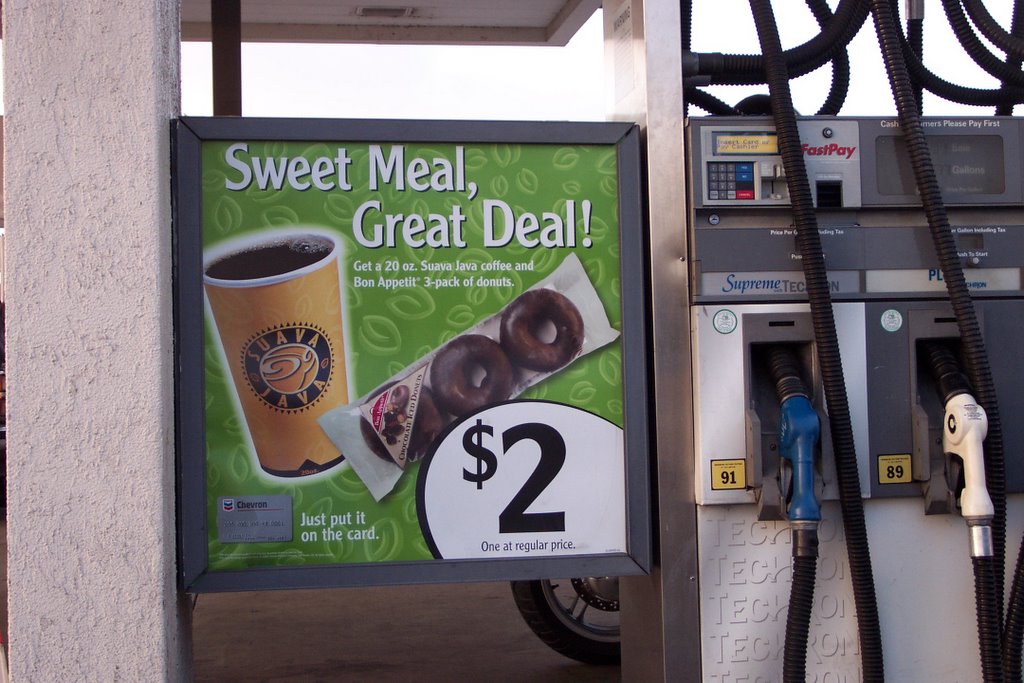
During a recent fill-up at Chevron, placards promoting the use of credit and debit cards to pay for two-bucks worth of coffee and donuts clearly drove home the merchant interchange issue.
"Just put it on the card," is the promoted message.
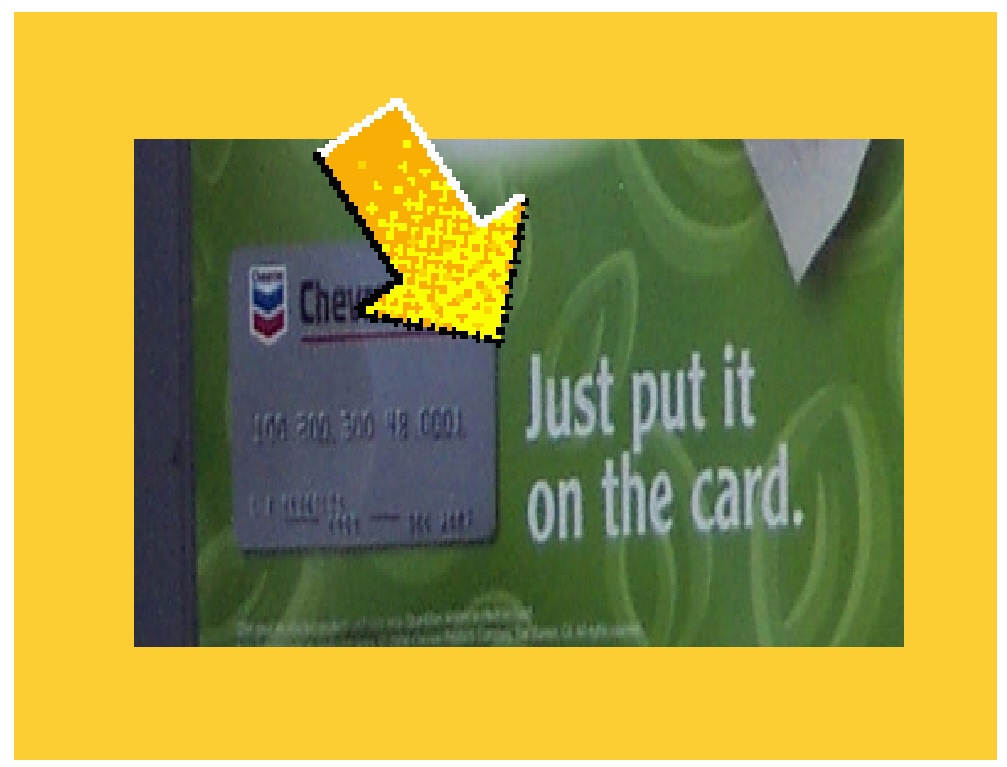
It is one thing when you use your Priority Club Rewards Visa Signature card (r) at Cartier. But, at service stations, fast food restaurants and the million of other businesses which ring up small transactions, Visa, MasterCard and the banks are using their market power and making bank on the backs of consumers and merchants.
Take a two-dollar purchase with your debit card, for instance. Typically, there could be a flat $0.50 - $0.75 cents in merchant interchange fees to process that order. For a credit card transaction, there could be a minimum charge plus a percent of the total sa
 le which could be upwards of a dollar under certain processing plans. If merchants have slim margins to begin with, this means that ... well, you understand. This is a lot of "'dough'-nuts" and high degree of profiteering enjoyed by the banks.
Indeed, as the signage promotes: "Sweet Meal, Great Deal," but for whom? In this case, the promotion was not for a bank-branded card, but customers will use Visa and MasterCards too. Millions of companies do have customers who charge for even a cup of coffee: think Starbucks.
Retailers explai
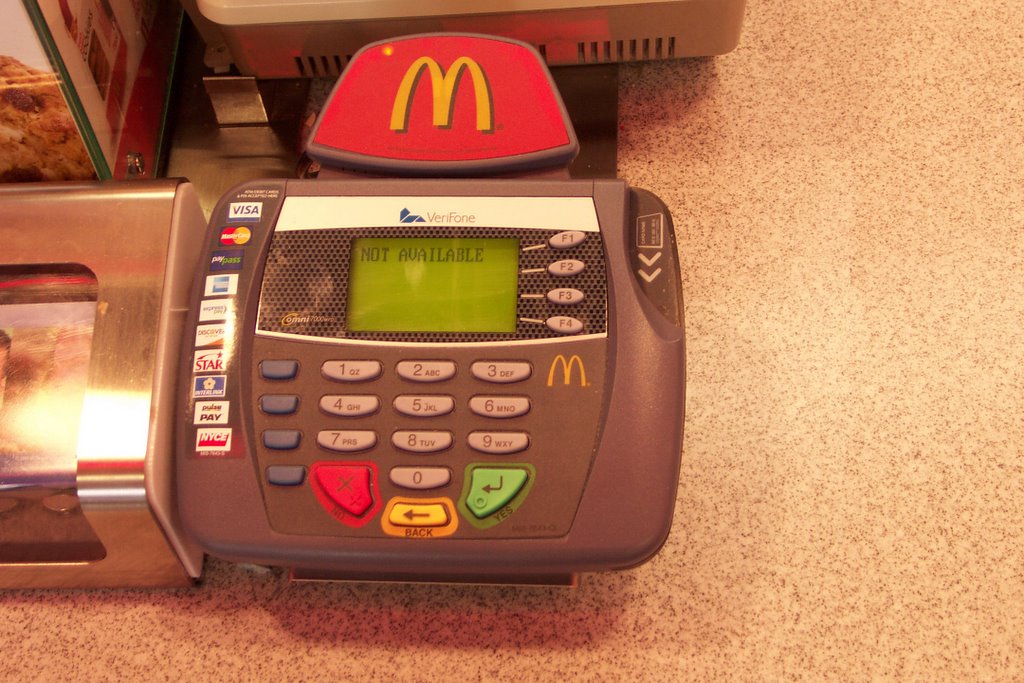 n these credit card associations' charges as colluding to set artificially high interchange fees paid to the banks. The banks cannot legally get together and fix these prices, which they do as alleged in our antitrust litigation. Yet, MasterCard and Visa continue to explain that the lawsuits are without merit. These bank-owned card associations point to the benefits of the the value of the services receive. That they are right about: there is great value, but the benefactors are the banks.
[source: WayTooHigh.com]
Monday, January 23, 2006
Banks want merchants to be silenced and pretend that U.S. laws are not being violated
Reuters released a detailed article on Jan 23rd about the credit card interchange litigation and how it may lead to "more than $100 billion in damages."
After reading the article, it was interesting to observe that the banks continue to be silent about arguing the law, explaining why their collusive practices are not in violation of the Sherman Antitrust Act, and why the alleged price-fixing is not illegal. Instead, they get groups like The International Card and Payment Council to explain to Reuters that "a merchant victory would reverberate disastrously." A consultant to Citibank articulated an even weaker solution: he wants the Federal Reserve to simply have the court dismiss the litigation or tender another way to resolve this without being "disruptive to the banking system and the U.S. economy.''
Ok. But, what about the banks illegal activities. What about the facts?
There is near silence even though Visa tries to protect itself from future litigation by adding independent members to its board. Even MasterCard is trying to insulate itself from future litigation by mortgaging its liabilities onto the public through an IPO. [We still think the MasterCard IPO will be delayed and eventually cancelled]. With all this gamesmanship, can Susan Molinari and her advocacy group which, remember: "enjoys the financial support from Visa USA" be far behind?
Whatever vocal weaponry they prepare to hurtle at us, The Credit Card Interchange Report - WayTooHigh.com is prepared to deflect every trick they launch against their customers (merchants and consumers). Using this forum, we are responding instantly and repeating the facts over and over again.
Click here to view a link to the Reuters article.
[source: WayTooHigh.com]
After reading the article, it was interesting to observe that the banks continue to be silent about arguing the law, explaining why their collusive practices are not in violation of the Sherman Antitrust Act, and why the alleged price-fixing is not illegal. Instead, they get groups like The International Card and Payment Council to explain to Reuters that "a merchant victory would reverberate disastrously." A consultant to Citibank articulated an even weaker solution: he wants the Federal Reserve to simply have the court dismiss the litigation or tender another way to resolve this without being "disruptive to the banking system and the U.S. economy.''
Ok. But, what about the banks illegal activities. What about the facts?
There is near silence even though Visa tries to protect itself from future litigation by adding independent members to its board. Even MasterCard is trying to insulate itself from future litigation by mortgaging its liabilities onto the public through an IPO. [We still think the MasterCard IPO will be delayed and eventually cancelled]. With all this gamesmanship, can Susan Molinari and her advocacy group which, remember: "enjoys the financial support from Visa USA" be far behind?
Whatever vocal weaponry they prepare to hurtle at us, The Credit Card Interchange Report - WayTooHigh.com is prepared to deflect every trick they launch against their customers (merchants and consumers). Using this forum, we are responding instantly and repeating the facts over and over again.
Click here to view a link to the Reuters article.
[source: WayTooHigh.com]
Sunday, January 22, 2006
Appendix of Most Popular Recent Postings
Banks Must Study "Moore's Law" To Reverse Unbridled Fee Increases
Other than winning The Golden Globe Awards, the film "Syriana" and the banks have much in common
"Erin Brockovich" Inspiration to WayTooHigh.com
Olympic spectators in Torino, Italy to pay half the U.S. interchange rate. Why?
Protestors Demonstrate Outside the National Retail Federation's Annual Conference in New York
Banks' Silence is Deafening
How Banks Might Plan to Attack Merchants
2006 Begins With Even Less Credit Card Competition
Credit Where It's Due
As other countries curb payments system abuses, our policy in this area looks more in need of an overhaul
Other than winning The Golden Globe Awards, the film "Syriana" and the banks have much in common
"Erin Brockovich" Inspiration to WayTooHigh.com
Olympic spectators in Torino, Italy to pay half the U.S. interchange rate. Why?
Protestors Demonstrate Outside the National Retail Federation's Annual Conference in New York
Banks' Silence is Deafening
How Banks Might Plan to Attack Merchants
2006 Begins With Even Less Credit Card Competition
Credit Where It's Due
As other countries curb payments system abuses, our policy in this area looks more in need of an overhaul
Saturday, January 21, 2006
Banks Should Study "Moore's Law" To Reverse Unbridled Fee Increases (WayTooHigh.com)

Several months ago, 30 Minute Photos Etc., lead plaintiff in the multibillion dollar class-action antitrust litigation against Visa, MasterCard and its member banks charged $5.00 to scan a picture to a digital CD. Today, that fee is low as just 5-cents. Technology has made this in-demand service super fast and much less costly. Within minutes of shoe boxes full of precious family pictures arriving, it is processed, scanned and prepared for same-day return delivery across the country.
Why is this so important and relevant to the interchange litigation?
All entrepreneurs understand, especially those involved in technology that we owe a great deal to Intel's cofounder. In 1965, Gordon Moore saw the future and fathered the popularly known prediction of "Moore's Law". This states that the number of transistors on a chip doubles about every two years. Over time, this observation about silicon integration has fueled the worldwide technology revolution which Moore's Law helped build.
The result: more performance, less cost. To personalize this, today your entire shoe boxes with generations of family photos are preserved on digital CDs, index prints and reprints ordered within minutes. Credit also goes to another technology leader, The Eastman Kodak Company and its cutting-edge high speed scanning and Kodak Image Capture Software. This is the engine that powers 30 Minute Photos Etc. and offers an ideal example of how methodically Moore's Law works. From $5.00 to 5-cents, and from what would have taken several days to now scarcely a few minutes to complete an entire order.
While Moore's Law deals with technology and decreasing costs, the financial industry slipped past this lesson and proven rule. And, merchants and retail customers are paying billions of dollars every year because of it.
Instead of practicing Moore's Laws, Visa and MasterCard employee "More's" Law. Seemingly, everything to them costs more - or at least they charge more. When 30 Minute Photos Etc. was founded in 1990, we were just a local retail photo center in southern California. Back then, like all retailers, we ordered bulky, multi-page charge card carbon receipts and used cumbrous credit card imprinters that we swiped the card through in order to transact a charge card. Afterwards, each receipt was bundled together and mailed out of state for processing. The clearing and reimbursement process took days. Back then, the interchange fees were cost based and there were just a handful of separate charges which were a fraction of what it is today.
Today, the actual cost to transact a single electronic charge transaction costs nearly the same at 30 Minute Photos Etc. as it does for Wal-Mart. The infrastructure, technology and ease-of-use makes the actual cost to operate this payment system nearly irrelevant when all the other bank fees are weighted in. But, to companies like MasterCard, it is "priceless"and constantly rising.
To better explain: now that the photo center's business is nationwide, and like most Ecommerce transactions, we are entirely beholdened to charge cards for transacting business. When an online photo order is submitted to 30minphotos.com, we have no idea what our cost is. Did the customer use a debt card? Signature Visa Card? Affinity / frequent flyer card? Foreign bank card? Or, one of the other choices that now represents nearly one-hundred separate interchange fees? It is anyones guess.
What all Ecommerce businesses have in common is discrimination. Purchase a box of Mrs. Fields cookies online and they are forced to pay a wide variety of interchange fees, but if you stop by their retail store and write a check, there is no charge. If you use a debit card from Canada's PIN Network in that nation there also is no fee. Yet, while restaurants can insist that customers pay in cash, online merchants are discriminated against. They face these unbridled, price-fixed, bank fees which on low margin sales, often yield rates more than their entire net profit.
Because The Credit Card Interchange Report - WayTooHigh.com has quickly grown to become a leading voice for merchants and regular contributor to the media, our call to stop this hidden tax on customers is gaining momentum every day. This is why we share this commentary with all our readers. We also hope that Visa, MasterCard, the banks, their agents, public relations, political advocacy groups and planetary-sized teams of lawyers who regularly visit WayTooHigh.com study Moore's Law too educate, accelerate performance and exponentially decrease merchant interchange fees.
30minphotos.com is just a single example which represents millions of businesses that used technology to transform its business. Now, the banks also need to catch up and seamlessly integrate technology to speed up payment transactions and lower the costs. Even in the less technologically-advanced nations of Brazil and Italy, their interchange fees are just half the rate in the U.S. and they face greater levels of fraud and costs.
Consider what Intel shared: Today, people find parts of their lives enhanced by technology. Families and friends who connect in an instant, sharing photos, playing games and trading advice, all while overcoming great distances and time differences. Doctors who access the Internet in the examining room, verifying the latest updates on chemical reactions, alternatives, and availability of your elder parents' prescriptions. On-the-go parents who can carry games and other digital entertainment for their younger children on sleek, light and portable devices that also allow them to call their older, free-spirited teenagers to check on their well-being. Entrepreneurs who launch new business models, ultimately enabling new market segments, companies, products and services, and employment sectors to grow.
Underlying and enabling all these experiences are advancements in technology as defined by Moore's Law ... So, rhetorically, why are Visa and MasterCard still practicing science fiction with "More's" Law?
Instead of working with their two core customers - merchants and consumers - they are using politics, high-powered lawyers and public relations to protect their fiefdom and thwart off what inevitably helps every other business model.
Beyond interchange fees, a study of ATM fees is another reverse-study of Moore's Law. Banks charge upwards of $2 to draw money from your account. You may also pay fees to another bank involved in the transaction. Soon, more banks will curtail waiving certain other fees. These add up. Bankrate.com reports that the bank's earn more than $4.3 billion from these excess fees. Reuters reported that "in South Carolina, where Wachovia, Bank of America, BB&T and Carolina First Bank account for about half of the banking market, customers can feel the effects. For example, Bank of America, which has 16,700 cash machines worldwide, reported in 2004 that card fee income increased by 50 percent over 2003 to $4.5 billion. And through the first nine months of 2005, the bank was on pace to surpass the 2004 total, reporting $4.2 billion in fee income."
The banks argue these services are a benefit and the fees are for the convenience of using their services. This is much like when you purchase tickets to a concert or sporting event from Ticket Master and they tack on a myriad of charges; one is even identified as a "convenience fee".
In the real world, businesses cannot charge such exploitive fees. For instance, when 30 Minute Photos Etc. invented and launched its new high-speed photo scanning service, we used technology and the lower fees to our advantage. Customers embraced the fact that due to technology we no longer charge $5.00, but rather as low as 5-cents to instantly scan and preserve their generations of family pictures with ShoeboxReprints.com. conversely, while banks explain their ATM fees are a necessity to cover "out-of-network ATM's," consumers describe it differently: unconscionable profiteering.
Unlike the automated interchange payment system network, there are steep costs for servicing and maintaining ATM machines. But, even so, to charge a mom - urgently rushing out to an ATM to get money to buy last-minute groceries for her family - as much as $4.00 in ATM fee is, like interchange fees ... WayTooHigh
[source: WayTooHigh.com]
Friday, January 20, 2006
How Banks Might Plan to Attack Merchants (WayTooHigh.com)
What does it take to protect the banking industry's $25 billion annual merchant interchange treasure?
One caper had their allies recently writing a commentary suggesting the only solution to the interchange merchant litigation are Congress and legislative sanctuaries.
Another trick is to eclipse the fact that the banks are accused of illegally inflating credit card transaction fees by plotting to unload MasterCard's liabilities through a stock sale early this year. The Credit Card Interchange Report - WayTooHigh.com maintains this strategy could fail as investors are educated on and thwart this chancy scheme.
Beyond patronizing political support and stock sales, expect the banks to continue working closely in 2006 with an arsenal of corporate advocacy groups. To better characterize the types of resources available to Visa and MasterCard, the following is an overview of resources they may use in an attempt to safeguard their fleeting grip on retailers and consumers.
While omitting the company names, these profiles are representative of the types of organizations available to the banks to protect their interests. Although not implying any specific involvement, these corporate profiles come directly from various websites to better help merchants and consumers know what we are up against. [We are in no way suggesting any of the below unidentified companies are connected with the banks - even though some do promote banks as clients on their websites.]
Profiles of Various Corporate Services Available to the Banks
COMPANY A: - Marketing intelligence company that analyzes and distills the opinions and perceptions of the online world. Scans blogs, message boards, opinion sites and other public forums. Processes the info and prepares actionable market insights about companies, products, people and issues. Enables clients to understand the opinions, perceptions, attitudes and behaviors of consumers, capturing and analyzing topics and issues of most importance to them. In the online community, consumers speak in the context of their lives, and how their lives interact with your brands and products. Most important, it's unprompted, unsolicited and timely.
COMPANY C: - This law firm provides clients with experience and advice in virtually every discipline of the law. They coordinate multifaceted teams in negotiation, dispute resolution and transactions. With lawyers in the United States, Europe and Asia, and extensive practices in Africa and South America, they can respond knowledgeably, effectively and quickly, whether the issue is local, regional, national or international. Their lawyers speak more than a dozen languages and are familiar with international business customs.
COMPANY D: - This management consultancy firm delivers tailored solutions to international organizations seeking to achieve their strategic goals through effective leadership and management of their human capital worldwide This organization uses surveys to collect data on a wide range of organizational issues to support effective planning and decision-making.
COMPANY E - This economics consulting firm specializing in financial and economic analysis of policy, regulatory, and litigation matters for corporations, governments and public-sector entities in the United States and worldwide. They combine the expertise and practices of its staff with research and support capabilities on a wide range of antitrust, regulatory and economic policy matters. The firm has experience in academics, senior government positions, and consultancies with analytical capabilities, testifying and advisory experience, and a thorough understanding of how governments operate. Its directors have been engaged by private parties from small businesses to multi-national Fortune 500 companies, and by local, national and international public-sector organizations.
COMPANY F - This information management company reviews competitors and analyzes information, like this website. They try uncovering the challenges businesses face to help make "fact-based decisions." This includes identifying pertinent issues that will impact their clients with reactive facts to stay ahead of the competition. From their website they explain a client profile: "The management team is becoming increasingly frustrated because it cannot accurately anticipate key issues that are impacting the company's business. The organization feels it is always reactive, communicating after the facts and is unsure of what to say. They need fact-based answers and need to be warned in advance."
COMPANY G - Business and Politics are closely commected at this bipartisan public affairs firm which works closely with "a wide range of Fortune 500, trade association, political campaign, and nonprofit clients to mobilize and motivate their stakeholders." Their website explains that their "team of professionals brings experience from a bipartisan range of some of the most successful grassroots movements in American history, including MoveOn.org, the NRA, the Draft Wesley Clark movement, and the Christian Coalition. Working together, they combine cutting-edge technology with established communications practices to create campaigns that are incredibly cost effective and make an impact. They specialize in "merging online advocacy technology with communications strategy to recruit, educate and mobilize client stakeholder networks. Our programs help clients shape public opinion, build and strengthen relationships with key stakeholder groups ... and generate outreach from stakeholders to key decision makers and the media to advance their public affairs agenda."
[source: WayTooHigh.com]
Wachovia Earns Record $6.64 Billion in '05; Citigroup Earnings Soared 30% in 4th Qtr
As bank earnings are announced this week, this marks another quarter with double-digit growth from the banks allegedly collusive, price-fixing practice of setting the merchant interchange fees. This time, for instance, Wachovia announce on Jan 19th that it reaped a 13 percent growth increase in fee and other income generated primarily by strong debit card interchange income and retail service charges.
Also on Jan 19th, Capital One Financial Corp. one of the country's largest credit card issuer of Visa and MasterCard announced that its profits were up 44 pct on fees.
On January 20th, Citigroup reported its fourth-quarter earnings rose 30%; revenues from the bank's international cards business advanced 19% to $1.36 billion.
Also on Jan 19th, Capital One Financial Corp. one of the country's largest credit card issuer of Visa and MasterCard announced that its profits were up 44 pct on fees.
On January 20th, Citigroup reported its fourth-quarter earnings rose 30%; revenues from the bank's international cards business advanced 19% to $1.36 billion.
Thursday, January 19, 2006
Mastercard, VISA face legal complaint over fees
19 January 2006
BERLIN - A legal complaint aimed at cutting fees charged by credit card groups VISA and Mastercard was lodged Thursday with the country's federal monopolies body, a retail lobby group said in a statement.
The complaint says fees charged both companies to stores accepting credit cards average 1.5 per cent per sale and that this has prevented widespread acceptance of credit cards in Germany.
"Only 5 per cent of all retail sales are paid for with credit cards," said the statement by the German Retail Association which made the complaint to the Bundeskartellamt - the federal mergers and monopolies commission.
The complaint calls on the Bundeskartellamt to order fees to be reduced and for improved transparency aimed at improving credit card sector competition "which hardly exists."
Spain, the German lobby group notes, has ordered a step-by-step reduction of Intercharge fees to between 0.54 per cent and 1.10 per cent by 2008.
[source: Expatica's German News]
BERLIN - A legal complaint aimed at cutting fees charged by credit card groups VISA and Mastercard was lodged Thursday with the country's federal monopolies body, a retail lobby group said in a statement.
The complaint says fees charged both companies to stores accepting credit cards average 1.5 per cent per sale and that this has prevented widespread acceptance of credit cards in Germany.
"Only 5 per cent of all retail sales are paid for with credit cards," said the statement by the German Retail Association which made the complaint to the Bundeskartellamt - the federal mergers and monopolies commission.
The complaint calls on the Bundeskartellamt to order fees to be reduced and for improved transparency aimed at improving credit card sector competition "which hardly exists."
Spain, the German lobby group notes, has ordered a step-by-step reduction of Intercharge fees to between 0.54 per cent and 1.10 per cent by 2008.
[source: Expatica's German News]
Wednesday, January 18, 2006
Credit Where It's Due (WSJ Commentary)
The Wall Street Journal, Jan 12, 2006 "Review & Outlook" (subscription required)
[The following "Letter to the Editor" was submitted to The Wall Street Journal by the co-editors of The Credit Card Interchange Report - WayTooHigh.com in response to a Jan 12 commentary, "Credit Where It's Due"].
Dear Editor,
The Jan 12 Review & Outlook "Credit Where It's Due" chose to poke fun and mock millions of retailers and consumers with weak arguments. Could it be the WSJ is supportive of these sky-high merchant interchange fees because among your largest sources of ad revenues are the very banks which stand accused of collusion and illegal price-fixing?
This multi-billion dollar antitrust litigation against Visa, MasterCard and the banks which own the two leading credit card companies is not about the convenience they provide to merchants, but about why interchange fees in the U.S. are double the rate in Italy and other industrialized nations. It is about why Canada has a zero debit card interchange fee, as is the case with check writing in the U.S. which also enjoys no interchange fee - even though the cost and labor associated with clearing and processing non-electronic transactions is substantial.
Instead, this is about market power, not by Wal-Mart, but the banks which set these fees. When you suggest that government intervention would just cause a mess, think of the mess caused by Enron and World Com from an unbridled lack of intervention. Remember, Congress enacted antitrust protections more than one-hundred years ago to give the courts authority to remedy these practices. Now, we see giant multi-national retailers joining with "mom and pop" entrepreneurs in support of this litigation; all on the same side as consumers who are burdened with paying this $25 billion annual hidden tax.
Sincerely,
Mitch Goldstone and Carl Berman
co-editors
The Credit Card Interchange Report - WayTooHigh.com
[The following "Letter to the Editor" was submitted to The Wall Street Journal by the co-editors of The Credit Card Interchange Report - WayTooHigh.com in response to a Jan 12 commentary, "Credit Where It's Due"].
Dear Editor,
The Jan 12 Review & Outlook "Credit Where It's Due" chose to poke fun and mock millions of retailers and consumers with weak arguments. Could it be the WSJ is supportive of these sky-high merchant interchange fees because among your largest sources of ad revenues are the very banks which stand accused of collusion and illegal price-fixing?
This multi-billion dollar antitrust litigation against Visa, MasterCard and the banks which own the two leading credit card companies is not about the convenience they provide to merchants, but about why interchange fees in the U.S. are double the rate in Italy and other industrialized nations. It is about why Canada has a zero debit card interchange fee, as is the case with check writing in the U.S. which also enjoys no interchange fee - even though the cost and labor associated with clearing and processing non-electronic transactions is substantial.
Instead, this is about market power, not by Wal-Mart, but the banks which set these fees. When you suggest that government intervention would just cause a mess, think of the mess caused by Enron and World Com from an unbridled lack of intervention. Remember, Congress enacted antitrust protections more than one-hundred years ago to give the courts authority to remedy these practices. Now, we see giant multi-national retailers joining with "mom and pop" entrepreneurs in support of this litigation; all on the same side as consumers who are burdened with paying this $25 billion annual hidden tax.
Sincerely,
Mitch Goldstone and Carl Berman
co-editors
The Credit Card Interchange Report - WayTooHigh.com
Tuesday, January 17, 2006
Protestors Demonstrate Outside the National Retail Federation's Annual Conference in New York

(January 16, 2006) --(BUSINESS WIRE)--A photo, taken today outside the Javits Center during the National Retail Federation's annual conference in New York, showing protestors demonstrating against interchange fees associated with major credit card companies.
Today in New York, dozens of protestors stood outside the Javits Center during the National Retail Federation's annual conference and expo. The group was demonstrating against the interchange fees that card associations like Visa, MasterCard and American Express charge to retailers every time a consumer uses a credit card. The topic of interchange fees has been a hot button issue for the retail industry, which paid approximately $39 billion in fees to the card associations last year. Ultimately, this cost is passed onto consumers through higher prices.
Retailers interested in eliminating their interchange fees were encouraged to sign up at stopinterchangenow.com. *
# # #
The well-organized protestors waved placards with a wide variety of messages that largely parodied the multi-million dollar advertising campaigns and slogans from the leading charge card firms. The slogans included:
"Visa: Everywhere You Want a Fee"
"More Than $pare-Change Without Interchange"
"American Express: My Life. My Card. My Fee.
"MasterCard. Not Priceless"
* Stopinterchangenow.com believes merchants should be able to accept credit payment from customers without having a significant portion of profits siphoned off by the card associations. The 1996 class-action lawsuit, brought by NRF and the nation’s largest retailers, opened the marketplace for payment alternatives outside of the "Honor All Cards" rule. Finally that alternative is on its way and a credit revolution is coming. Soon all merchants will be able to accept credit without paying interchange fees.
Monday, January 16, 2006
Other than winning The Golden Globe Awards, the film "Syriana" and the banks have much in common (WayTooHigh.com)
[Editors note: On Nov. 16th, we first published the below commentary and are republishing it again after the film's success at The Golden Globe Awards]

(Nov 16, 2005) U.S. Senator Diane Feinstein's office invited the co-editors of The Credit Card Interchange Report - WayTooHigh.com to The Academy of Motion Picture Arts and Sciences in Los Angeles on Nov 12th for an advance screening of the Warner Bros. political thriller "Syriana".
Editing of the film by executive producer Steven Soderbergh, who directed "Traffic" and "Erin Brockovich," just completed last week.
Staring George Clooney and Matt Damon, this ambicious movie will be released in December. It involves brokering back-room deals in Washington and the intrigues and corruption within the global oil industry. The multiple storylines are weaved together to illuminate the human consequences from the fierce pursuit of wealth and power.
Why is this important to the credit card interchange litigation against Visa, MasterCard and its member banks?
The powerful U.S. oil companies fictionally portrayed in Syriana were involved in complex corruption and corporate mischief with explosive impact upon the world. While the backdrop for Syriana involves the global oil industry, there are many parallels to the depths of illegal corporate maneuvering we assert are practiced by the banks which own Visa and MasterCard. Their collusive price-fixing and global reach parallels many aspects of this fictional movie about failures of government.
Syriana illuminates the inner workings of what easily can relate to the banking industry and the executives who keep it running. In portraying the considerable influence and exploitation through many points of view, there are startling parallels to the fight against the multinational banks' anticompetitive practices.
Just as "The China Syndrome" in the late 1970s, "Wall Street" in the 1980s and "Erin Brockovich" in the 1990s drew attention to corporate greed, so too will this film.
Gordon Gekko's "Greed is good" speech in "Wall Street," symbolized a decade. Yet that famed phrase is about to be overshadowed by the new corporate-speak from actor Tim Blake Nelson in Syriana:
"We have laws against corruption precisely so we can get away with it. Corruption is our protection. Corruption keeps us safe and warm. Corruption is why you and I are prancing around in here instead of fighting over scraps of meat out in the street. Corruption ... Is why we win."

(Nov 16, 2005) U.S. Senator Diane Feinstein's office invited the co-editors of The Credit Card Interchange Report - WayTooHigh.com to The Academy of Motion Picture Arts and Sciences in Los Angeles on Nov 12th for an advance screening of the Warner Bros. political thriller "Syriana".
Editing of the film by executive producer Steven Soderbergh, who directed "Traffic" and "Erin Brockovich," just completed last week.
Staring George Clooney and Matt Damon, this ambicious movie will be released in December. It involves brokering back-room deals in Washington and the intrigues and corruption within the global oil industry. The multiple storylines are weaved together to illuminate the human consequences from the fierce pursuit of wealth and power.
Why is this important to the credit card interchange litigation against Visa, MasterCard and its member banks?
The powerful U.S. oil companies fictionally portrayed in Syriana were involved in complex corruption and corporate mischief with explosive impact upon the world. While the backdrop for Syriana involves the global oil industry, there are many parallels to the depths of illegal corporate maneuvering we assert are practiced by the banks which own Visa and MasterCard. Their collusive price-fixing and global reach parallels many aspects of this fictional movie about failures of government.
Syriana illuminates the inner workings of what easily can relate to the banking industry and the executives who keep it running. In portraying the considerable influence and exploitation through many points of view, there are startling parallels to the fight against the multinational banks' anticompetitive practices.
Just as "The China Syndrome" in the late 1970s, "Wall Street" in the 1980s and "Erin Brockovich" in the 1990s drew attention to corporate greed, so too will this film.
Gordon Gekko's "Greed is good" speech in "Wall Street," symbolized a decade. Yet that famed phrase is about to be overshadowed by the new corporate-speak from actor Tim Blake Nelson in Syriana:
"We have laws against corruption precisely so we can get away with it. Corruption is our protection. Corruption keeps us safe and warm. Corruption is why you and I are prancing around in here instead of fighting over scraps of meat out in the street. Corruption ... Is why we win."
"Finally, a Useful Blog" (NACS Magazine)
From the January 2006 edition of NACS Magazine (page 64)....
"Finally, a Useful Blog. You've not alone in thinking that interchange rates are too high. The aptly named www.WayTooHigh.com agrees, providing regular updates drawing attention to issues affecting merchants and consumers. It says that the goal of its daily blog is to reform and antiquated, costly and unfair payment system and explain why interchange is a hidden tax on consumers."
"Finally, a Useful Blog. You've not alone in thinking that interchange rates are too high. The aptly named www.WayTooHigh.com agrees, providing regular updates drawing attention to issues affecting merchants and consumers. It says that the goal of its daily blog is to reform and antiquated, costly and unfair payment system and explain why interchange is a hidden tax on consumers."
Friday, January 13, 2006
Background News on Lead Plaintiff, 30 Minute Photos Etc.
To help personalize the interchange litigation, this news profile relates to lead plaintiff, 30 Minute Photos Etc.
The company operates a retail and national online boutique photo service. Like most ecommerce businesses, one-hundred percent of their online orders are generated through charge card transactions. Yet, with nearly one-hundred separate interchange fees, it is almost impossible to identify the cost for each transaction. On small order transactions, most of the sale is paid to the banks for processing the transaction.
[source: WayTooHigh.com]
The company operates a retail and national online boutique photo service. Like most ecommerce businesses, one-hundred percent of their online orders are generated through charge card transactions. Yet, with nearly one-hundred separate interchange fees, it is almost impossible to identify the cost for each transaction. On small order transactions, most of the sale is paid to the banks for processing the transaction.
[source: WayTooHigh.com]
Thursday, January 12, 2006
Mexico Takes Lead in Forcing Lower Interchange Fees (Bloomberg)
Citigroup, Bilbao to Lower Mexican Credit Card Fees, People Say
Jan. 12 (Bloomberg) -- Mexican banks, bowing to pressure from central bank Governor Guillermo Ortiz, agreed to lower fees on credit and debit cards at a cost of $100 million in annual revenue, bankers who helped draft the proposal said.
The charges the banks plan to lower are so-called interchange fees, or the money the merchant's lender pays the bank that issued the card. The fee makes up part of the bigger commission that banks levy on shops to process card payments. That overall fee reaches as much as 4.5 percent in Mexico.
Mexico is joining the U.S., U.K., Spain and Australia in seeking to lower fees that banks levy on retailers, restaurants and other businesses to process card payments.
[source: Bloomberg, click here for complete coverage]
Jan. 12 (Bloomberg) -- Mexican banks, bowing to pressure from central bank Governor Guillermo Ortiz, agreed to lower fees on credit and debit cards at a cost of $100 million in annual revenue, bankers who helped draft the proposal said.
The charges the banks plan to lower are so-called interchange fees, or the money the merchant's lender pays the bank that issued the card. The fee makes up part of the bigger commission that banks levy on shops to process card payments. That overall fee reaches as much as 4.5 percent in Mexico.
Mexico is joining the U.S., U.K., Spain and Australia in seeking to lower fees that banks levy on retailers, restaurants and other businesses to process card payments.
[source: Bloomberg, click here for complete coverage]
Wednesday, January 11, 2006
Visa USA Net Income Soars 72%
[WaytooHigh.com, editorial comment: We were delighted with the opening remarks by Visa USA's CEO and president. This was a watershed moment. Mr. Coghlan reflected that due to his background as a former merchant, he is interested in "exploring new and more creative ways of working cooperatively with merchant partners." This speaks volumes about his commitment to his customers. As fellow entrepreneurs and retailers, we find these heartfelt comments to be reaffirming and. looking forward, an important new beginning].
Excerpts from the Visa USA Annual Report 2005
1) "Net income increased 72 percent, to more than $360 million, heralding a rapid return to a positive equity position soon after the Retailers settlement."
2) "With respect to existing litigation, I want to comment specifically about interchange lawsuits brought against Visa and other payment systems by merchants. As a former merchant, I understand the tremendous economic pressures merchants face. I believe that there are better ways than lawsuits to lower costs. While we remain confident in our ability to defend interchange from merchant and other attacks, I won’t let anything stand in the way of our exploring new and more creative ways of working cooperatively with merchant partners to help them achieve their goals and better serve their customers. If we can find solutions that work for all of us, we will have an opportunity afforded few others." - John Philip Coghlan, Chief Executive Officer and President
3) "Multidistrict Litigation Proceedings. During 2005, merchants who accept Visa-branded payment cards have filed a number of additional cases against Visa U.S.A. Inc. and other defendants, asserting violations of the federal antitrust laws, and seeking treble damages for alleged overcharges in merchant discount fees, along with other relief. Currently, nearly fifty additional cases, most of which are asserted is purported class actions, are pending against Visa U.S.A. Inc. On October 19, 2005, the Judicial Panel on Multidistrict Litigation (“JPML”) issued an order establishing a Multidistrict Litigation (“MDL”) in the Eastern District of New York before the Honorable John H. Gleeson, to coordinate pretrial proceedings in these cases. Fourteen of the cases have already been ordered transferred to the Eastern District of New York; the JPML has been notified of the remaining potential “tag-along” actions, and those cases have been or likely will be included on a Conditional Transfer Order in the near future. Plaintiffs in four of the potential “tag-along” actions have indicated that they intend to oppose inclusion of those cases in the MDL. The majority of these cases include claims that interchange violates Section 1 of the Sherman Act. A number of the cases, either instead of or in addition to claims based on interchange, assert that Visa’s “no surcharge” and other rules violate Section 1 of the Sherman Act. Some of the cases also allege that Visa ties “Premium Credit Cards” to other Visa credit cards, and that Visa ties “Payment Guarantee Services” to other network services. Several cases claim that Visa has monopolized the “debit and credit services market” in violation of Section 2 of the Sherman Act. Additional allegations in some of these cases include the claim that Visa’s “no-surcharge” rule constitutes a conspiracy to monopolize trade in violation of Section 2 of the Sherman Act, and that Visa engages in exclusive dealing. One case claims that interchange constitutes unjust enrichment and violates the consumer protection statutes of 22 states and another alleges monopolization claims under Arizona unfair competition law. Finally, a few cases allege that the purported tying of “commercial products” to a merchant’s acceptance of other Visa services violates Section 1 of the Sherman Act, that the same conduct constitutes attempted monopolization and conspiracy to monopolize in violation of Section 2 of the Sherman Act, and that merchant discounts are supracompetitive as a result of the alleged tying arrangements. Proceedings in all of these cases are at an early stage."
[source: Visa USA Annual Report]
Excerpts from the Visa USA Annual Report 2005
1) "Net income increased 72 percent, to more than $360 million, heralding a rapid return to a positive equity position soon after the Retailers settlement."
2) "With respect to existing litigation, I want to comment specifically about interchange lawsuits brought against Visa and other payment systems by merchants. As a former merchant, I understand the tremendous economic pressures merchants face. I believe that there are better ways than lawsuits to lower costs. While we remain confident in our ability to defend interchange from merchant and other attacks, I won’t let anything stand in the way of our exploring new and more creative ways of working cooperatively with merchant partners to help them achieve their goals and better serve their customers. If we can find solutions that work for all of us, we will have an opportunity afforded few others." - John Philip Coghlan, Chief Executive Officer and President
3) "Multidistrict Litigation Proceedings. During 2005, merchants who accept Visa-branded payment cards have filed a number of additional cases against Visa U.S.A. Inc. and other defendants, asserting violations of the federal antitrust laws, and seeking treble damages for alleged overcharges in merchant discount fees, along with other relief. Currently, nearly fifty additional cases, most of which are asserted is purported class actions, are pending against Visa U.S.A. Inc. On October 19, 2005, the Judicial Panel on Multidistrict Litigation (“JPML”) issued an order establishing a Multidistrict Litigation (“MDL”) in the Eastern District of New York before the Honorable John H. Gleeson, to coordinate pretrial proceedings in these cases. Fourteen of the cases have already been ordered transferred to the Eastern District of New York; the JPML has been notified of the remaining potential “tag-along” actions, and those cases have been or likely will be included on a Conditional Transfer Order in the near future. Plaintiffs in four of the potential “tag-along” actions have indicated that they intend to oppose inclusion of those cases in the MDL. The majority of these cases include claims that interchange violates Section 1 of the Sherman Act. A number of the cases, either instead of or in addition to claims based on interchange, assert that Visa’s “no surcharge” and other rules violate Section 1 of the Sherman Act. Some of the cases also allege that Visa ties “Premium Credit Cards” to other Visa credit cards, and that Visa ties “Payment Guarantee Services” to other network services. Several cases claim that Visa has monopolized the “debit and credit services market” in violation of Section 2 of the Sherman Act. Additional allegations in some of these cases include the claim that Visa’s “no-surcharge” rule constitutes a conspiracy to monopolize trade in violation of Section 2 of the Sherman Act, and that Visa engages in exclusive dealing. One case claims that interchange constitutes unjust enrichment and violates the consumer protection statutes of 22 states and another alleges monopolization claims under Arizona unfair competition law. Finally, a few cases allege that the purported tying of “commercial products” to a merchant’s acceptance of other Visa services violates Section 1 of the Sherman Act, that the same conduct constitutes attempted monopolization and conspiracy to monopolize in violation of Section 2 of the Sherman Act, and that merchant discounts are supracompetitive as a result of the alleged tying arrangements. Proceedings in all of these cases are at an early stage."
[source: Visa USA Annual Report]
Regulating Merchant Interchange Fees (Washington State Senate Bill)
Introduced by Sen. Ken Jacobsen on January 6, 2006, to prohibit a merchant's financial institutions from charging a credit/debit card holder's financial institution interchange fees that are more than 1.5% of the total transaction. More info.
[source: Washington State Legislature]
[source: Washington State Legislature]
Saturday, January 07, 2006
Banks' Silence is Deafening (WayTooHigh.com)
With nearly 200 unique postings and daily visits recorded from around the globe, including from the Federal Reserve in the U.S. and international equivalents, The Credit Card Interchange Report - WayTooHigh is among the first daily chroniclers of this multi-billion dollar issue.
As major banks, along with the two credit card associations which they own and control (Visa and MasterCard) regularly visit this site, a growing question is why has their silence been so deafening? They know the issues and they have read the postings. Yet, their silence is further distancing themselves from their two primary customers - merchants and consumer cardholders.
Even the media visitors to this site have questioned several issues we have addressed. They too don't know if the new American Express-branded bank cards will incur the traditionally higher interchange fees. Another recent question: why will spectators to the Winter Olympics in Italy face merchant interchange fees that are nearly half the rate charged in the United States?*
Retailers are asking questions. Consumers are demanding answers. The media too continues to also largely face a silent, non-response from the banks.
As well-known entrepreneurs and business leaders, the co-editors of The Credit Card Interchange Report - WayTooHigh.com also knows how the game of multinational public relations works. Don't respond. Stay silent. Hope the noise and focus fragments.
Conversely, the questions against the banks continue to mount and go unanswered. Retailers want to understand why the collusive, anti-competitive, price-fixing claims continue to impair this vital payment system while other nations have successfully addressed and are resolving the problems.
Just as films like "The China Syndrome" in the late 1970s, "Wall Street" in the 1980s and "Erin Brockovich" in the 1990s drew attention to corporate greed, so too will The Credit Card Interchange Report - WayTooHigh.com
In the case of American hero, Erin Brockovich, she had the power and human spirit to battle a regional adversary. The difference is this time the credit card interchange fight blankets the entire nation. It affects all retailers and all consumers. Even a single-mother raising her children in an inner-city is affected. When she buys milk at a corner convenience store, her cash payment is actually helping to subsidize the premium Signature Visa cardholders' frequent flyer mileage accruals.
The battle is larger than Erin Brockovich faced, yet the adversaries remain largely silent. The defendants in this litigation stand acused of violations and illegal activities, including of the Sherman Antitrust Act.
The real-life story of Erin Brockovich took place before the Internet, before blogs and other high-tech forms of online activism. While Ms. Brockovich had to walk door to door, the co-editors of WayTooHigh.com just press a few buttons and instantly are read by many, including the banks, their affiliates following this site, consumers and other interested parties across the nation and abroad.
Like Ms. Brockovich's triumph over insurmountable odds, The Credit Card Interchange Report - WayTooHigh.com remains confident that with more transparency, daily updates and increased understanding this battle too will quickly lead to a victory for every consumer and every retailer - even if the banks deafening silence hopes we just go away.
[source: WayTooHigh.com]
* (source, NACS Magazine, July 2005, "Cards Costs" 2004, MPC)


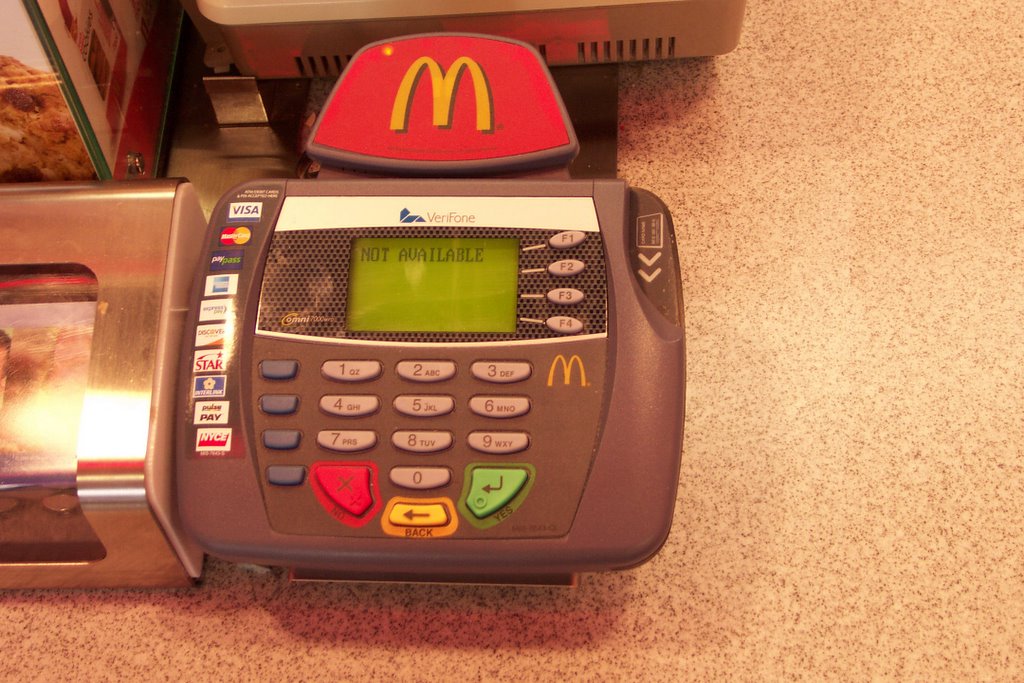
Sunday, January 01, 2006
2006 Begins With Even Less Credit Card Competition (WayTooHigh.com)

Among the biggest financial news stories during 2006 will be the illegal, inflated credit card interchange transaction fees charged by credit card issuers. This case affects all merchants, consumers and pits the banks against its two core customer bases.
The Credit Card Interchange Report - WayTooHigh.com will expand its coverage due to the nearly daily updates on this multi-billion antitrust litigation. Even though there has been a further consolidation within the credit card issuing business, the news and issues circling this enormous issue continues to balloon.
With Bank of America's acquisition of MBNA, there are now just five giant credit card issuers. Combined, they control nearly 3/4 of all the business. The irony is that even as Bank of America doubles the size of its credit card business, and their cost to process accounts will be scaled down, retailers are poised to face huge new merchant interchange fees.
With Bank of America completing its $34 billion acquisition of MBNA, the result also means an immediate reduction of credit card competition and forecasts for even more oppressive merchant interchange fees. The combined valuation means that Bank of America is now the country's largest credit card issuer.
During the next few weeks, The Credit Card Interchange Report - WayTooHigh.com will begin profiling weekly "Interchange Horror Stories." The goal is to draw additional attention to this $25 billion annual hidden consumer tax. With this latest acquisition, we anticipate drawing more attention and fodder from Bank of America's new role as lead purveyor of illegal price-fixing of merchant interchange fees.
[source: WayTooHigh.com]
FAST FACT: No Interchange fee works in Canada

DID YOU KNOW?
The U.S. is among the only market where interchange fees are increasing. Canada, for example, has a zero interchange fee for debit cards; their PIN Network is the most popular way to transaction business. U.S. Interchange fees are 3-times higher than in Australia and two-times higher than in the UK.
Subscribe to:
Posts (Atom)